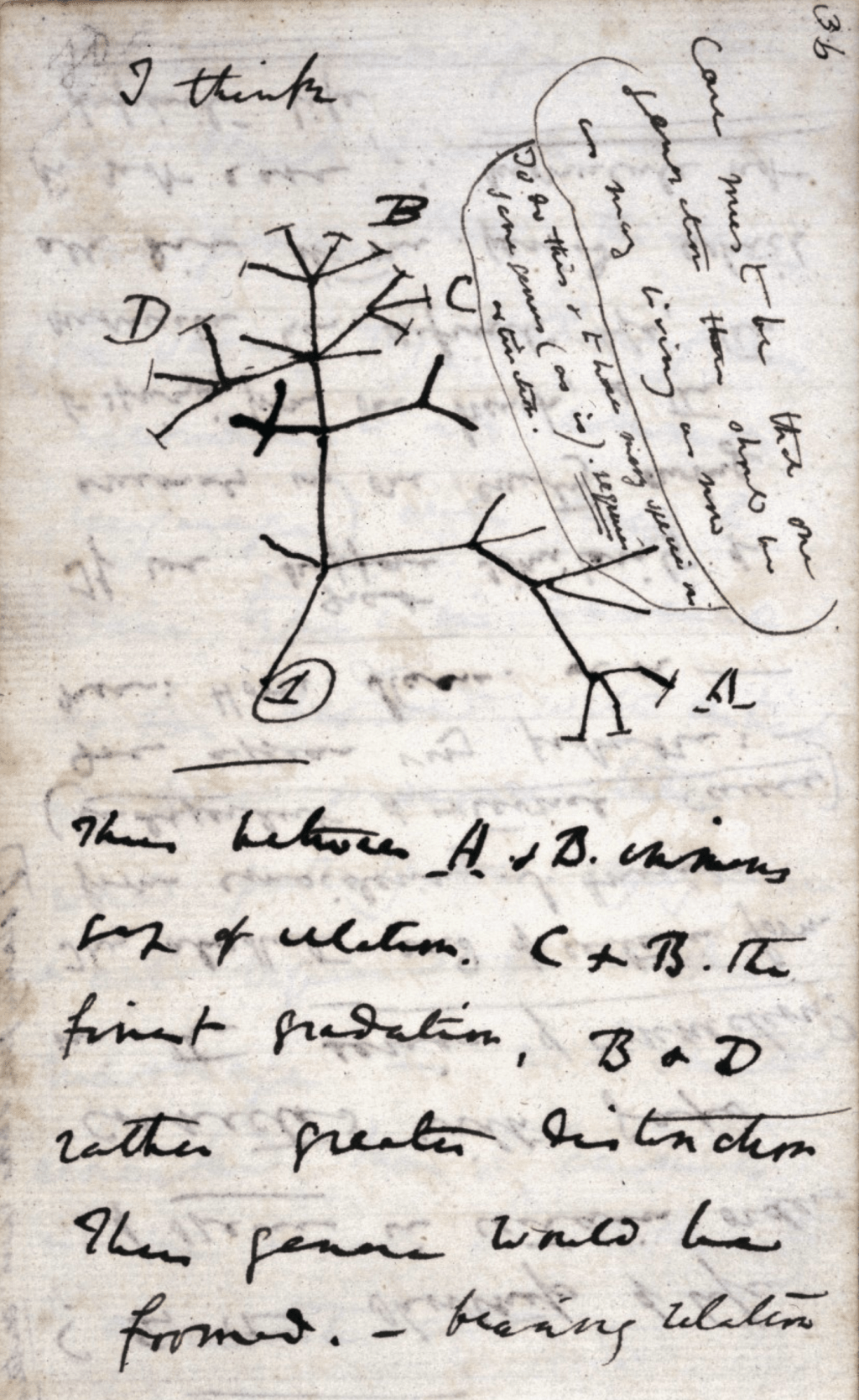
Two months ago I gave a talk to fifty students at the Universidad Nacional de Rosario’s School of Music. The topic was human rights in 2025 and the professor had requested “an American perspective.” But before that, the professor asked me to explain to students by way of an introduction how I got to where I am — he could have meant physically, but he was interested in my career (freelance, transdisciplinary, writer-editor, sometimes speaker, etc.). I opened my talk with the image above.
Charles Darwin drew this “tree of life” into his notes in 1837, twenty-two years before he published his most famous work, On the Origin of Species, in which he introduced the theory of evolution that now dominates our understandings of speciation on Earth. To the roomful of students in Argentina, I explained that Darwin’s tree and my CV share an aesthetic; they are similarly committed to branching out.
The branches
Because I know many people (the kinds who start-up businesses and film and research and write and in other ways make and therefore contract others), or because I am almost always a willing participant who works hard at being likeable in addition to diligent, or because I am at least mildly interesting to be around, or because I love learning as much as I love writing, or because, simply, I am lucky, I have worked at many things, related and not, to my academic training.
I founded a nonprofit organization in 2003 with two friends and then rebranded (and re-founded) that organization with an additional friend four years later. More than one hundred employees and board members of this nonprofit now work with and for tens of thousands of high school students and teachers across the United States to get students, especially those living in low income communities, into and through college. That’s on one branch of my CV. On another branch, one that came into being a decade ago, I assistant produced a rock music video for a corporate-sponsored, Mexico City-based boy band. That video, with 2.4 million views achieved before TikTok mainstreamed such viralability, is likely to be the most viewed work of art with which I am ever involved. No matter the really smart, engaging, important to science and the world content I draft and redraft and edit in collaboration with academic authors each year. As Vonnegut wrote in 1969, “so it goes.”
Beyond: I cofounded a gallery in Mexico City, taught unlikely anthropology courses at art schools in the United States, convinced the National Science Foundation to fund my volunteer-bartending-as-participant-observation-based research in Oaxaca, Mexico where I studied family structure and the service economy for six years. I played volleyball, coached volleyball, community organized, taught the old, young, and in-between. I even worked in futures trading for two years.
These experiences that defy linear explanations and thus easy communication of who and what I have become are the foundation for my transdisciplinarity. They have given me the experience as well as confidence to educate educators, to write with and for and to coach writers across disciplines. Further, they evince my social self and my commitment to building and maintaining sincere, respectful, and productive relationships with all of those who surround me: invite me to collaborate, and I am likely to say yes.
The trunk
If you return to Darwin’s sketch, you will see that the branches depart from a trunk. The trunk that structures my tree-of-life-like CV is research, writing, and editing (which I take to be a single practice). I have spent dozens of hours editing books on school reform in the United States, nonprofits that do HIV-testing in China, businessmen in Cameroon… I have spent hundreds of hours editing books (and in two cases, helping authors to win book awards) on environmental racism in Baltimore, social welfare and the rise of the U.S. radical right, movements to transform corporate rail around the world, and the care work provided by children living in households with tuberculosis in Zambia.
I have written, edited, and/or proofed funding applications and business proposals for friends and colleagues, sometimes as favors and sometimes as work, since I began my career as a graduate student in 2004. As an editor, my commitments to grammar, including to the Oxford comma when publishers permit, are unwavering. I have written and/or ghostwritten more than 100 blogs for for-profit and non-profit organizations since I began ghostwriting in 2016. I know academic-ese as well as grant- and budget-ese, I know business-speak, and I love the poetic best of all. As an educator, I know that an instructor’s investment in a course begets student investment in a course. And I know, too, that co-learning and co-teaching work best — even in the least likely of contexts.
Others’ dreams
I wrote once that editing allows me to try on others’ projects — it is a kind of temporary borrowing of others’ dreams as I work to find or refine the wording that hooks and holds members of grant committees or venture capital firms who are the purveyors of capital in the research and start-up worlds. My book and article editing allows for the same borrowing of dreams, though at a later-stage, while teaching is a bricking of the paths along which my students traipse in pursuit of their dreams — a collaborative process to which they have invited me.
To research, write, edit, educate, support, consult, maintain relationships with my clients and colleagues as they pursue their dreams are things that leave me delirious with excitement. Almost. Key to this near-delirium if you will is the current state of affairs (funding cuts, anti-science and anti-academic legislation) in the United States and Argentina alike. I believe in knowledge and knowledge-making, and I believe in a long line of activists who have fought for knowledge from unexpected contexts. Imagine Darwin had he lacked funders, editors and presses, a population of readers who were also believers in and promoters of science and of learning.
As a content creator and educator, and especially as an academic, I identify with these activists. I recognize the importance of their varied positionalities, and I hope that my own position in the freelance labor market can prove as significant, not just to the individuals who work with me, but to the world we are building for our children.
 Monument City
Leave a comment